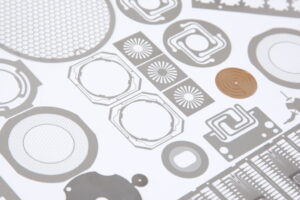
Solid-state bonding technology demonstrates high reliability across a wide range of advanced fields, from cooling components in electronic devices to structural members in the aerospace industry. This article outlines the basic concepts of solid-state bonding and explains how it differs from other joining methods. It also provides a detailed overview of representative solid-state bonding techniques, along with the advantages and manufacturing examples of diffusion bonding.
What Is Solid-State Bonding?
Solid-state bonding is a joining technique in which base materials are heated to below their melting point and pressed together to break down surface oxide films, enabling atomic-level diffusion and bonding.
Because the process does not involve melting, it minimizes microstructural alteration and residual stress in the base materials, enabling high-strength, highly airtight joints.

How Solid-State Bonding Differs from Other Joining Methods
| Joining Method | Advantages | Disadvantages | Typical Applications |
| Solid-State Bonding | ・Minimal material degradation and distortion because the base material is not melted ・High-strength joining is possible, even for dissimilar materials | ・Requires specialized equipment ・The process can become complex for thick plates or large bonding areas | Electronic components, semiconductors, aerospace parts |
| Welding | ・Widely used and supported by many general-purpose systems ・Suitable for thick plates and large structures | ・Large heat-affected zone (HAZ) ・Joining dissimilar metals requires advanced techniques and strict conditions | Buildings, bridges, ships |
| Brazing | ・Enables joining of dissimilar metals and complex shapes ・Relatively small distortion | ・Risk of contamination due to filler metal(brazing alloy) ・Joint strength may decrease in high-temperature environments | Heat exchangers, piping components |
| Adhesive Bonding | ・Low-temperature process with simple equipment ・Excellent insulation and sealing performance | ・Limited heat resistance and chemical resistance ・Strength may degrade over time due to aging | Consumer electronics housings, composite panels |
Solid-state bonding involves minimal microstructural change or residual stress from heat, and because it does not involve melting, the formation of voids and cracks is suppressed. It delivers excellent performance in electronic cooling components that require microchannels and high airtightness, as well as in joining dissimilar materials with large thermal expansion differences.
Representative Types of Solid-State Bonding
| Process | Advantages | Disadvantages | Typical Applications |
| Friction Stir Welding (FSW) | ・High strength in thick aluminum plates No fumes or spatter | ・Limited to specific joint geometries (e.g., butt joints) ・Significant tool wear when applied to steel | Aircraft panels, EV battery cases |
| Friction Welding | ・Rapid joining of cylindrical components, including dissimilar axes ・Capable of joining dissimilar metals (requires advanced techniques and strict conditions) | ・Limited to circular cross-sections ・Precise axial alignment required | Shafts, pipes |
| Ultrasonic Welding | ・Low-temperature, high-speed process with compact equipment ・Effective for thin dissimilar metal sheets | ・Limited bonding area ・Difficult to apply to thick plates | Wire harnesses, lithium battery tabs |
| Diffusion Bonding | ・Excellent airtightness, high precision, and superior heat resistance ・Enables fabrication of complex 3D flow channels | ・Requires long holding times ・Requires high vacuum conditions | Cold plates, sensor components |
Friction Stir Welding
In this process, a rotating tool is pressed into the base material to induce plastic flow, stirring and forging the joint interface to create a unified bond. It is widely used for long, continuous joints between aluminum plates and has been adopted for EV battery cases and railway vehicle panels.
Friction Welding
A rod-shaped material is rotated at high speed, and the surface layer is plasticized by frictional heat. The materials are then joined under high pressure. Because material loss is minimal and automation is easy, this method is well-suited to mass production of components such as motor shafts and hydraulic piston rods.
Ultrasonic Welding
Ultrasonic vibration at 20–40 kHz breaks down oxide films on metal surfaces, completing the joint within tens of milliseconds. It is suitable for multi-point joining of thin dissimilar metal sheets, such as copper–aluminum and copper–nickel and is used in applications such as lead frames for power devices.
Diffusion Bonding
In a vacuum environment, the materials are heated to temperatures ranging from several hundred °C to around 1,200 °C while a pressure of approximately 10 MPa is applied and maintained for several hours. Without melting the base materials, atoms at the interface migrate and diffuse into each other, achieving metallurgical bonding. This method is essential for cooling plates and high-density microchannel components that require complex internal flow paths.
Advantages of Diffusion Bonding
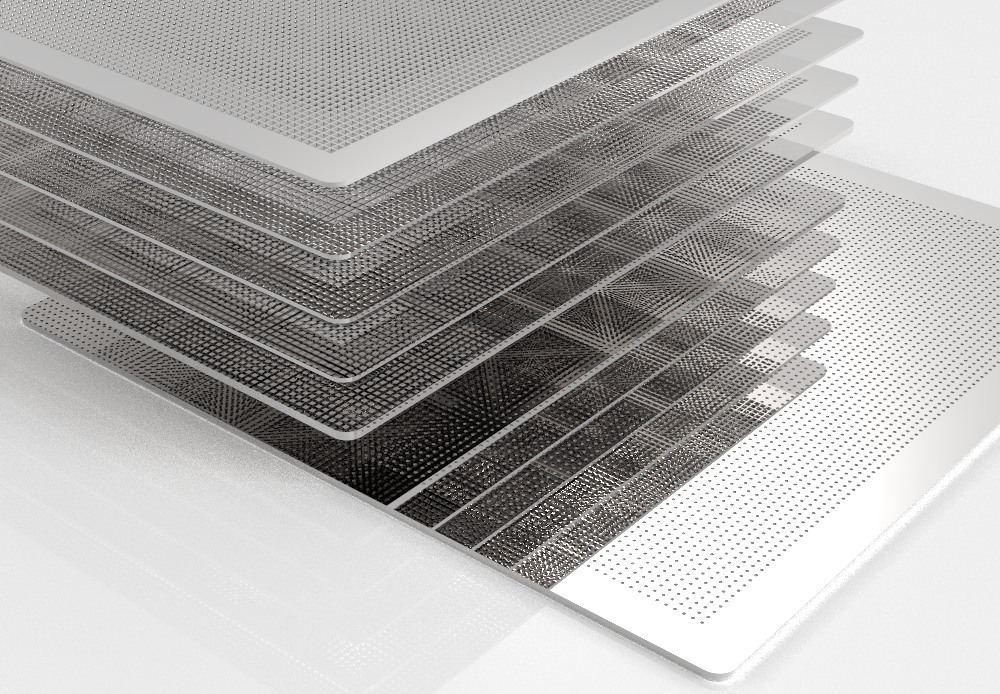
- Enables the fabrication of 3D internal flow channels and mesh laminations that are impossible to achieve through conventional machining
- Provides excellent airtightness and pressure resistance, maintaining performance even under vacuum and high-temperature cycling conditions
- Generates minimal residual stress at joints between dissimilar metals or materials of different thicknesses
- Maintains high-dimensional accuracy after bonding, reducing post-processing and finishing work
- Eliminates the need for adhesives or filler metals, minimizing outgassing and contamination risks
Due to these advantages, diffusion bonding is increasingly adopted in reliability-critical fields such as aerospace, semiconductor manufacturing equipment, and medical devices.
Manufacturing Examples of Diffusion Bonding
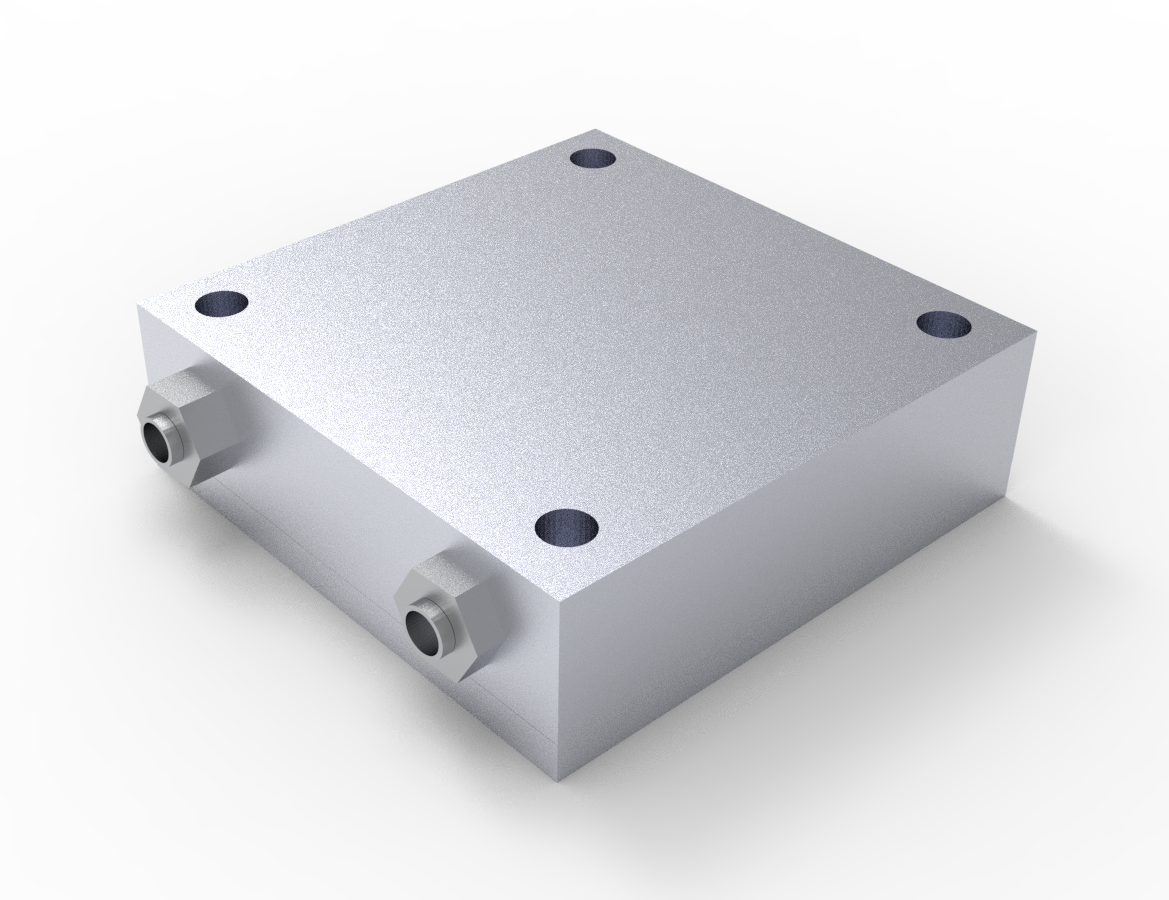
Cold Plates
Aluminum or copper plates with microchannels formed by photo-etching are stacked in multiple layers and integrated through diffusion bonding.
Compared with conventionally machined products, this approach significantly improves heat dissipation performance and has been successfully implemented in high-performance servers and semiconductor testers.
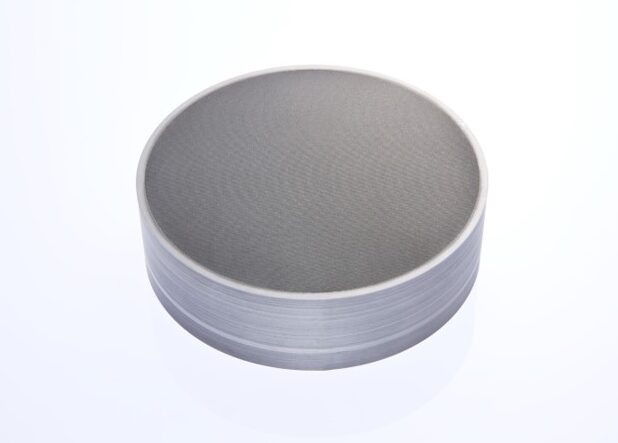
Multilayer Etched Filters
Dozens to hundreds of ultra-thin metal sheets (approximately 0.05 mm thick) are laminated and diffusion-bonded. By varying pore sizes across layers, particles are captured in stages, achieving highly efficient filtration.
These filters are used in clean liquid and gas transport systems and semiconductor chemical filtration applications.
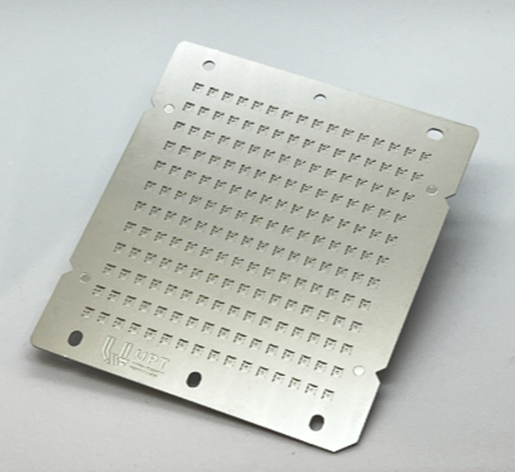
Transport Trays
A cavity structure capable of high-density electronic component placement is formed by laminating 0.2 mm-thick stainless steel (SUS) sheets.
Diffusion bonding ensures gap-free integration, providing excellent cleanability and durability while maintaining high positioning accuracy in automated transport lines.
Leave Diffusion Bonding to UPT
United Precision Technologies (UPT) specializes in photo-etching and diffusion bonding as its core technologies, providing one-stop support from prototyping through mass production. If you are looking to increase design flexibility for cooling components, filters, or precision trays, or if you need to improve joint strength and airtightness, please feel free to contact us.